Last Updated on January 2, 2026 by Kevin Chen
When designing MBR systems, membrane area is a critical parameter. It directly affects system capacity, operational safety margins, and membrane service life. For engineers and project decision-makers, understanding how membrane area is calculated is essential to making informed choices in membrane selection, system sizing, and operational management.
This article explains the principles of membrane area calculation from a professional engineering perspective and illustrates how to evaluate membrane area scientifically using Sperta’s real project experience.
Why Do We Need to Calculate Membrane Area?
When purchasing MBR membrane modules, manufacturers typically provide labeled specifications such as “10 m²,” “22 m²,” or “35 m².” On the surface, these values seem straightforward. However, we have repeatedly encountered the following issues:
“Two modules, both labeled “30 m²”, can show completely different filtration performance in operation.”
“Some modules list impressive membrane areas, but once disassembled, the effective filtration length is far shorter than advertised.”
“Certain manufacturers calculate membrane area based on theoretical geometric area rather than effective filtration area, leading to misleading or inflated values.”
“Clients who select membranes based on exaggerated area figures often experience higher flux stress, faster fouling, and more frequent chemical cleaning.“
I have personally seen multiple cases in which customers designed their membrane tanks based on an overstated membrane area from another supplier. As a result, TMP increased rapidly during early operation, and the system had to reduce flux or add additional modules—causing avoidable cost overruns and project delays.
Given these issues, it becomes essential to understand what truly determines membrane surface area. Before we can calculate it correctly, we must break down the structural parameters that define the MBR module’s actual filtration area.
Key Parameters for Membrane Area Calculation
- Effective Filtration Length (H)
Refers to the portion of the membrane fiber that actually participates in filtration.
Note: Effective length ≠ is the total fiber length. The upper potting, lower potting, and other inactive zones must be excluded. - Membrane Fiber OD (Outer Diameter = 2 x r)
Typical fiber outer diameters range from 1.9 ~ 2.8 mm.
A larger diameter increases the effective area per fiber, but may reduce packing density. - Number of membrane fibers (N)
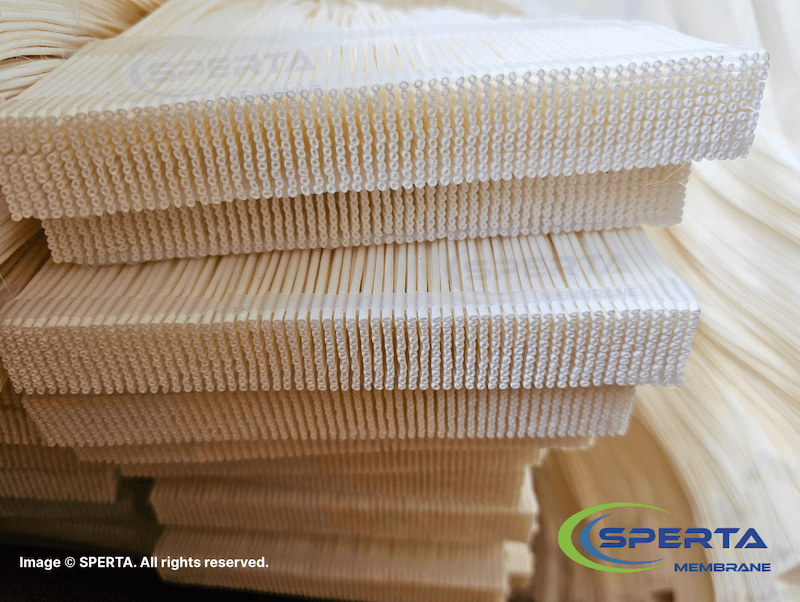
Number of fibers per bundle × number of bundles per module = total fiber count per module.
This parameter directly determines the module’s total effective filtration area.
How to Calculate MBR Membrane Surface Area?
Calculation Formula for Single MBR Membrane Fiber
A single membrane fiber can be treated as a cylinder. Its lateral surface area is calculated as:
Membrane Area=2 × π × r × h
where 2r is the fiber outer diameter, and h is the effective length.
Calculation From Single Fiber to Module Area
Single fiber area × number of fibers = total module membrane area

SPERTA’s Engineering Approach in Membrane Area Calculation
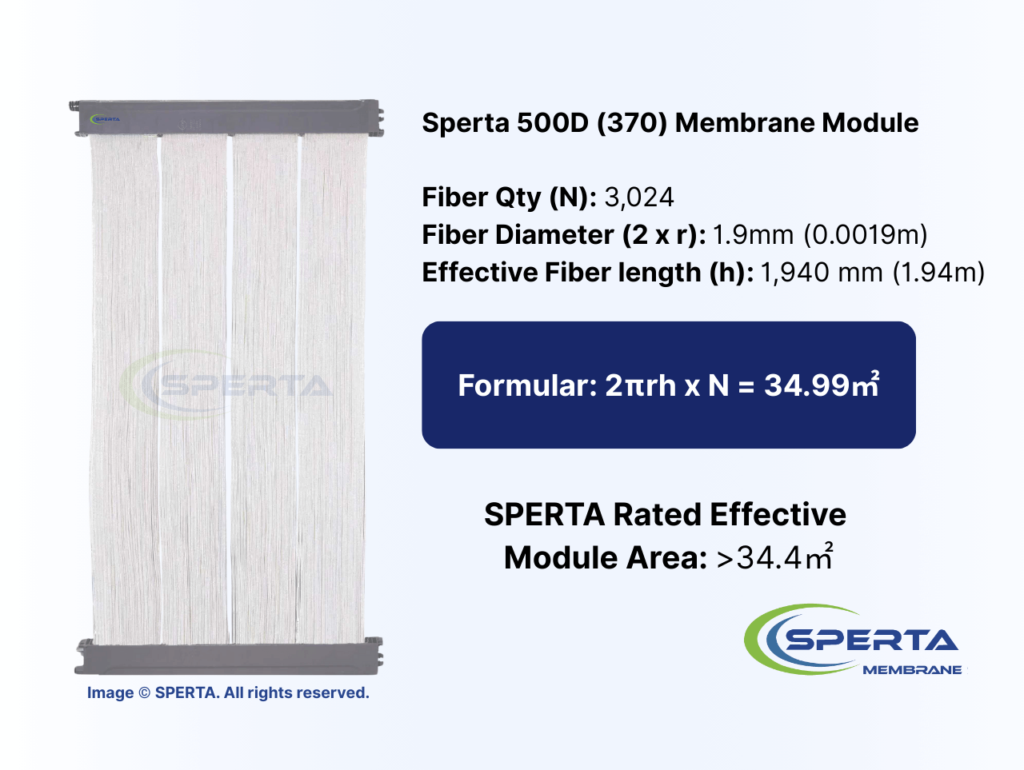
Taking the SPERTA 500D(370) membrane module as an example:
Assume a membrane fiber radius of 0.00085 m and an effective length of 1.94 m.
To achieve a standard filtration area of 34.4 m², the theoretical number of fibers required is calculated as:
Fibers (N) = 34.4 / (2 × π × r × h) = 2,972
In actual SPERTA production, additional fibers are typically added to ensure the rated permeate capacity and to compensate for potential effective area losses over time. As a result, the actual filtration area of a single SPERTA module is usually slightly higher than the nominal value, providing customers with an additional operational safety margin.
After calculating membrane area using fiber diameter and the effective length, we still need to consider two additional factors before applying these values to real system design:
- Packing Density
Packing density describes how tightly fibers are arranged within a given volume.
It affects both the effective membrane area per unit volume and the module’s hydraulic resistance. - Effective Filtration Area vs. Theoretical Geometric Area
The theoretical geometric area is primarily used for verification.
Only the effective filtration area should be used as the design basis.
All Sperta projects are designed with an effective filtration area to ensure realistic, reliable data.

Conclusion
Accurate membrane area calculation is the foundation of long-term stable MBR operation. Understanding membrane area calculation is not just about knowing a number—it enables you to control operational risks and optimize system performance.
For project-specific membrane area calculations based on flow rate, membrane type, and operating conditions, Sperta technical team can provide detailed calculation templates and engineering consultation to help your MBR system achieve optimal design and performance.