Last Updated on August 15, 2026 by Kevin Chen
If you’ve ever compared MBR membranes, you’ve probably asked the same question I hear from customers all the time: Should I choose an organic membrane or a ceramic one?
At first glance, the answer seems obvious. Ceramic membranes are stronger, more resistant to chemicals, and can tolerate harsher operating conditions. But if that’s true, why do most municipal MBR plants still use organic membranes?
Over the years, I’ve learned that membrane selection is not about choosing the material with the strongest specifications. It is about understanding the wastewater, operating conditions, maintenance strategy, and long-term project goals—and then choosing the membrane that fits them best.
What Are Organic and Inorganic MBR Membranes?
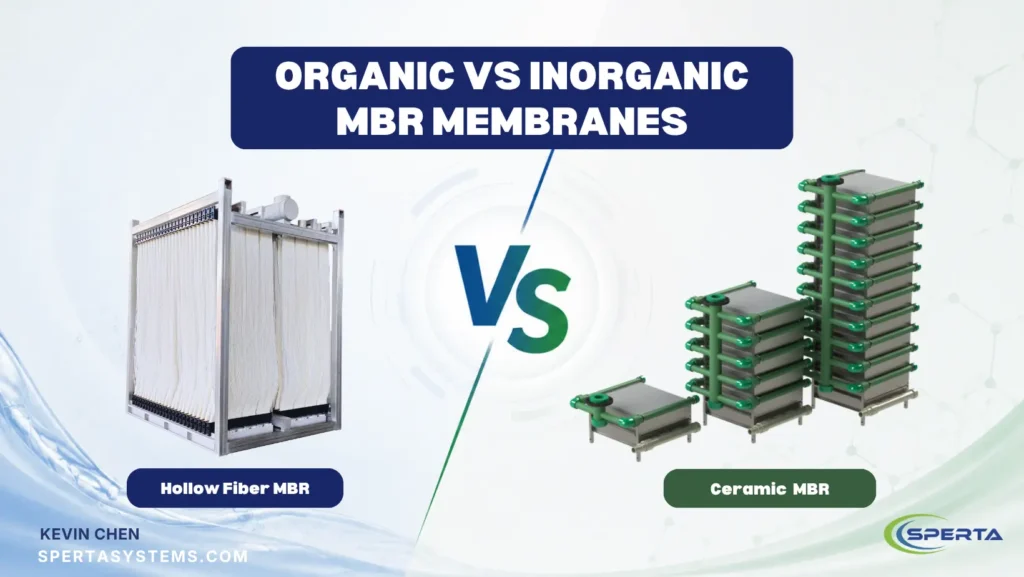
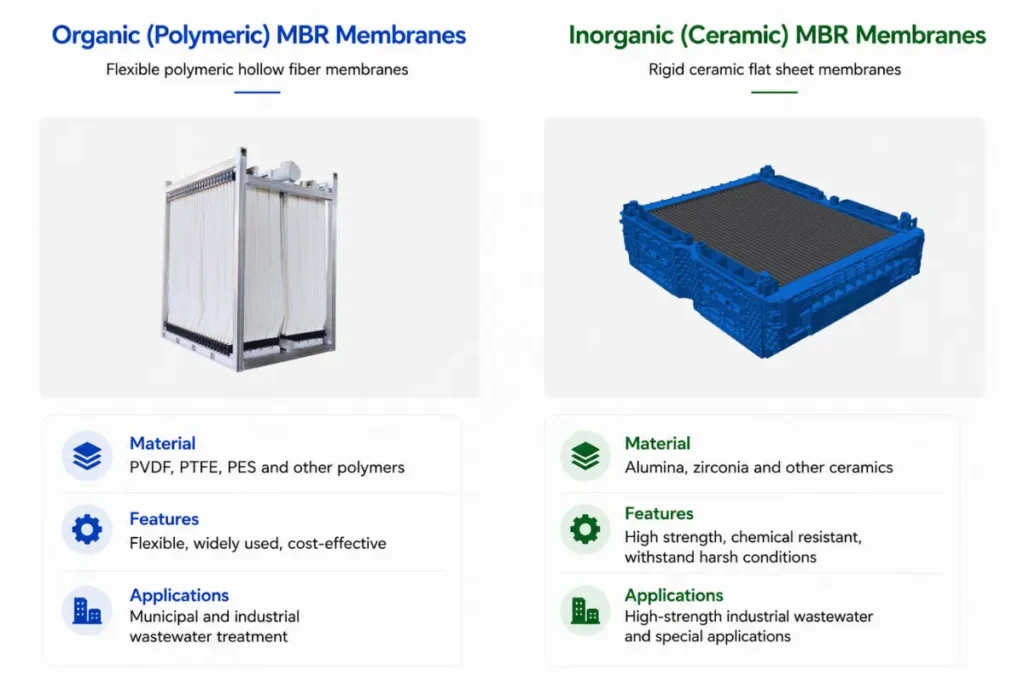
When people talk about MBR membranes, they are usually referring to two broad categories: organic (polymeric) membranes and inorganic (ceramic) membranes.
Organic MBR membranes are manufactured from polymer materials, with PVDF (polyvinylidene fluoride) being by far the most widely used in municipal and industrial wastewater treatment. Other polymer materials, such as PTFE and PES, are also used in certain applications, although they account for a much smaller share of the market.
Inorganic MBR membranes are commonly known as ceramic membranes. They are typically manufactured from materials such as alumina or zirconia and are valued for their excellent mechanical strength, chemical resistance, and ability to operate under more demanding conditions.
Typical Membrane Materials and Brands
| Membrane Type | Membrane Type | Typical Brand |
|---|---|---|
| Organic MBR Membranes | PVDF, PTFE and other polymers | Veolia/Zenon, Mitsubishi, Kubota, Toray, Sperta and other MBR suppliers |
| Inorganic MBR Membranes | Alumina, zirconia and other ceramic materials | Cerafiltec, Cembrane, Alsys Groupand and other ceramic membrane suppliers |
The brands listed above are provided as representative examples of membrane suppliers in the MBR industry. Different manufacturers may use different membrane formulations, fiber structures, and module designs even when the membrane material is the same.
Engineering Insight: Membrane material is only one part of MBR performance. Fiber or plate structure, module design, aeration, flux selection, cleaning strategy, and daily operation can be equally important.
Organic vs Inorganic MBR Membranes: A Practical Comparison
After understanding the two membrane categories, the next question is straightforward: how do they compare in real MBR applications?
From an engineering perspective, membrane selection is rarely based on a single property. Instead, it involves balancing capital cost, operating conditions, membrane durability, cleaning requirements, and long-term operating costs.
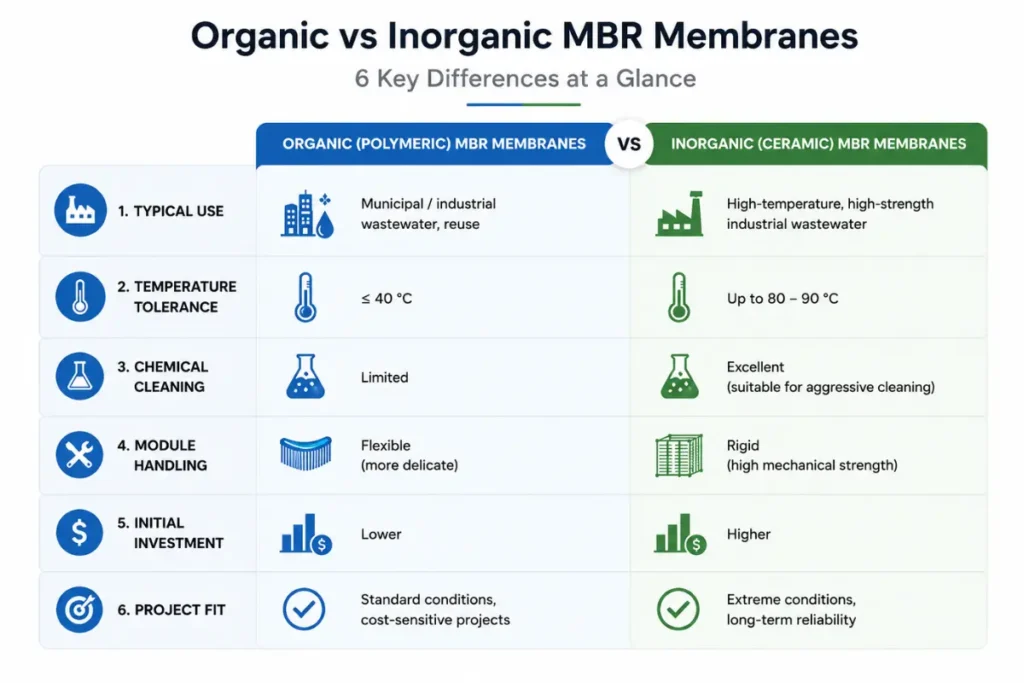
The table below summarizes the key differences between organic and inorganic MBR membranes used in wastewater treatment.
| Comparison Factor | Organic MBR Membranes | Inorganic MBR Membranes |
|---|---|---|
| Base Material | PVDF (mainstream), PTFE, PES | Alumina (Al₂O₃), Zirconia (ZrO₂), Titanium Oxide |
| Typical Pore Size | 0.03–0.4 μm | 0.05–0.2 μm |
| Operating Temperature | Typically ≤40°C | Up to 80–90°C (varies by manufacturer) |
| pH Tolerance | Approximately pH 2–10 | Approximately pH 0–14 |
| Oxidant Resistance | Limited by membrane chemistry | Excellent; suitable for aggressive chemical cleaning |
| Mechanical Strength | Flexible hollow fibers | Rigid ceramic structure |
| Typical Service Life | 5–10 years* | 10–20 years* |
| Membrane Replacement Cost | Lower | Higher |
| Initial Investment (CAPEX) | Lower | Higher |
| Typical Applications | Municipal wastewater, industrial wastewater, water reuse | High-temperature, high-strength industrial wastewater, harsh chemical environments |
*Actual membrane life depends on operating conditions, fouling control, cleaning strategy, and maintenance practices.
Which MBR Membrane Material Fits Different Applications?
Many people assume that the membrane with the best technical specifications is automatically the best choice. In real engineering projects, however, I rarely recommend a membrane material based on a single parameter. Instead, I always start by understanding the project itself.
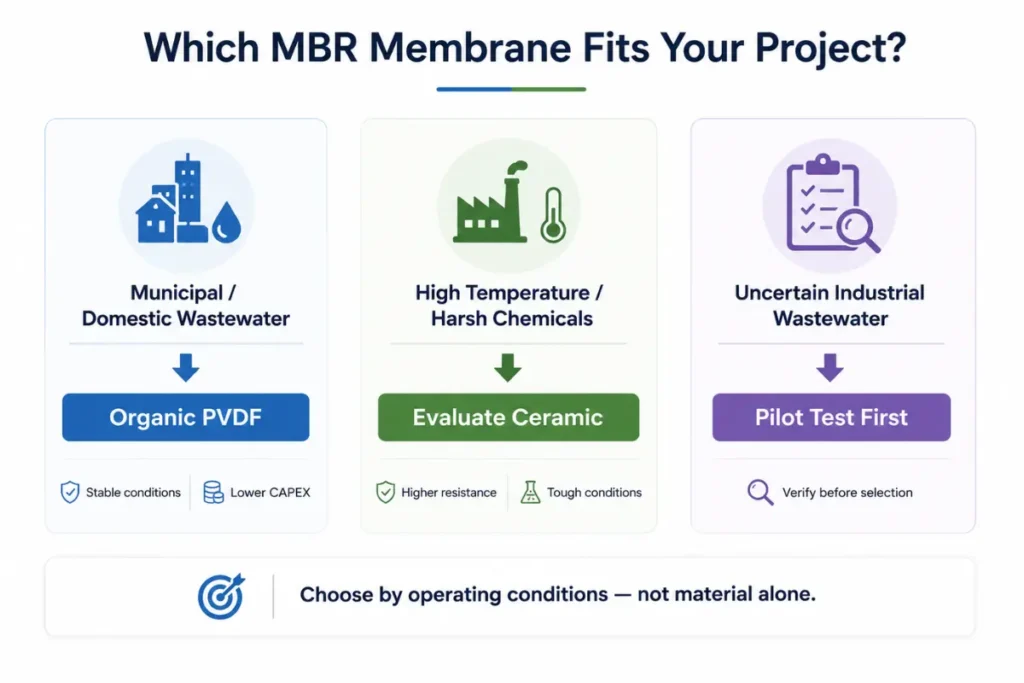
For municipal wastewater treatment, I generally recommend organic PVDF membranes as the first option. The reason is straightforward: municipal wastewater is relatively stable, operating temperatures are typically low, and there is usually no need for extreme chemical resistance or high-temperature operation. Modern PVDF membranes can deliver reliable long-term performance while offering lower capital investment, mature operating experience, and well-established maintenance practices. That’s why they remain the dominant choice for municipal MBR plants worldwide.
Organic membranes are also widely used in food and beverage wastewater, commercial buildings, residential developments, and many conventional industrial applications where operating conditions remain within polymeric membrane limits.
For specialized industrial wastewater, however, my approach is different. Projects involving high-temperature wastewater, high salinity, aggressive chemicals, or frequent exposure to strong oxidizing cleaning agents may exceed the practical operating range of polymeric membranes. In these situations, I usually evaluate whether a ceramic membrane is a better long-term solution. Although the initial investment is higher, its superior chemical resistance and thermal stability can reduce maintenance challenges and improve lifecycle economics in certain applications.
From my experience, no membrane material is ideal for every MBR project. The most important question isn’t “Which membrane is more advanced?”—it’s “Which membrane is better suited to your operating conditions?”
| Application | Typical Starting Point |
|---|---|
| Municipal and domestic wastewater | Organic PVDF membrane |
| Commercial and residential wastewater | Organic PVDF membrane |
| Food and beverage wastewater | Organic PVDF membrane in most cases |
| Conventional industrial wastewater | Evaluate water quality and cleaning requirements |
| Elevated-temperature wastewater | Evaluate ceramic membrane |
| Strong acid/alkali or aggressive cleaning | Evaluate ceramic membrane |
How to Evaluate MBR Membrane Selection?
When I evaluate an MBR membrane for a project, I do not begin by comparing product brochures or looking for the membrane with the highest individual specification. I first look at the operating conditions the membrane will face throughout its service life.
In practice, I usually focus on four areas.
Wastewater characteristics
I look beyond the basic wastewater category and focus on the characteristics that can directly affect membrane fouling and cleaning requirements. These may include oil and grease, fibers, inorganic scaling, abrasive particles, solvents, or other specific chemicals in the feed water.
These factors help determine how the membrane is likely to foul and what type of cleaning strategy the system will require.
Operating envelope
I then look at how the MBR system is expected to operate. Key parameters include operating temperature, MLSS concentration, design flux, transmembrane pressure (TMP), and membrane aeration intensity.
A membrane may have a wide allowable operating range on paper, but that does not necessarily mean the system should be designed close to those limits. I prefer to evaluate the membrane together with the overall process design and expected operating conditions.
Cleaning requirements
Cleaning is another important part of membrane selection. I consider the expected backwash frequency, chemically enhanced backwash (CEB), cleaning-in-place (CIP) requirements, as well as the chemicals and cleaning frequency likely to be used during long-term operation.
A membrane that performs well initially but requires frequent chemical cleaning may not necessarily provide the best overall solution for the project.
Project priorities
Finally, I consider what the project is actually trying to optimize. Some projects place greater importance on lower initial CAPEX, while others focus on energy consumption, downtime, membrane replacement intervals, or compatibility with an existing MBR system.
For retrofit projects in particular, membrane dimensions, module configuration, hydraulic connections, and existing operating practices can be just as important as the membrane material itself.
From my perspective, a successful MBR project is rarely determined by membrane material alone. Membrane material is only one part of the solution. The overall process design, aeration strategy, cleaning program, and day-to-day operation all play an important role in determining long-term membrane performance.
Key Questions Before Selecting an MBR Membrane
| Evaluation Area | What I Review |
|---|---|
| Wastewater characteristics | Organic loading, oils, fibers, scaling potential, abrasive solids and chemical exposure |
| Operating conditions | Temperature, MLSS, design flux, TMP and aeration |
| Cleaning strategy | Backwash, CEB/CIP frequency, chemicals and required recovery |
| Project type | New installation, expansion or membrane retrofit |
| Owner priorities | Initial investment, energy use, downtime and lifecycle cost |
| Local operating capability | Automation, staffing, spare parts and maintenance experience |
SPERTA’s Engineering Experience
SPERTA currently develops and manufactures hollow fiber PVDF MBR membranes. Even so, we do not assume that PVDF is suitable for every project.
I still remember one customer who contacted us specifically because they believed ceramic membranes would last much longer than polymeric membranes. After reviewing the project, however, we found it was simply a conventional municipal wastewater treatment application. The operating temperature was low, the wastewater characteristics were stable, and there were no unusually harsh cleaning requirements.
In that case, although ceramic membranes could potentially offer a longer service life, the additional investment would provide very limited practical benefit. After discussing lifecycle cost, maintenance requirements, and operating conditions with the customer, they ultimately selected our PVDF membrane solution, which was more suitable for the application.
We’ve also worked with customers already operating ceramic membrane systems. In one industrial wastewater project, the operator told us that the membranes required chemical cleaning more frequently than they had expected under their specific operating conditions. After reviewing the treatment process, we concluded that a properly designed PVDF MBR system would likely have provided a more economical solution for that particular application.
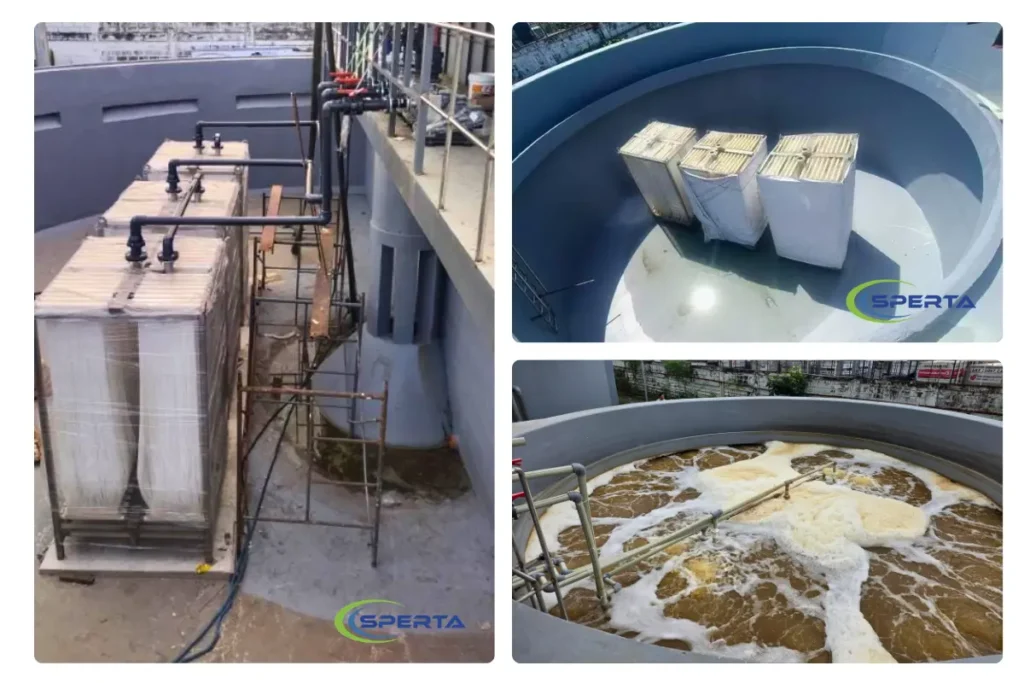
Of course, the opposite is also true. When we evaluate projects involving high-temperature wastewater, strong acids or alkalis, or unusually aggressive operating conditions, we openly recommend that customers consider ceramic membranes. These applications can exceed the practical operating limits of polymeric membranes, and recommending ceramic membranes is often the more responsible engineering decision.
From my perspective, good engineering isn’t about recommending the product you manufacture—it’s about recommending the solution that best fits the project. That’s the approach we’ve followed across hundreds of MBR projects, and it’s still the principle we use today.
Conclusion
There is no universally better MBR membrane material. Organic PVDF membranes remain a practical choice for most municipal and conventional industrial wastewater projects, while ceramic membranes deserve serious consideration in high-temperature, highly corrosive, or otherwise demanding applications.
Over the years, SPERTA has independently developed and manufactured hollow fiber PVDF MBR membranes, supplying customers in more than 60 countries and supporting hundreds of municipal and industrial wastewater treatment projects worldwide. That experience has reinforced one principle: successful membrane selection is not about choosing the most advanced material—it is about choosing the right solution for the application.
If you are planning a new MBR project or evaluating a membrane replacement, contact SPERTA to discuss the wastewater characteristics, operating conditions, and membrane options with our engineering team.